Dear Friends,
It is winter, the bleak midwinter, the interminable haul between the end of Christmas and the first crocus. I’ve been remembering a grey, ugly January afternoon many years ago when we still lived in Pennsylvania, when the snow had turned black with car exhaust. In those days, the kids were young and still needed me every moment; silence was rare, a solitary walk still rarer. But that frozen day, I needed to be by myself. I left the girls with Martin and tromped up a neighborhood hill to my dear friend, Nancy’s house. I lingered on the curb and surveyed her garden.
It was rather a mess: the chard and lettuces had shot to seed long ago; a tangled vine curved around the front door. I remembered that the summer before, robins had made a nest in the house eaves. Nancy had instructed the entire family to stop using the front door in order not to disturb the fledglings. A few short weeks later, she left the garden and the robins and lay down in a hospice bed; shortly afterwards, she died. She had battled cancer for three years. I watched as her three young children followed her casket up to the front of the church.
On that January afternoon, the robin’s nest was empty. Nancy was a zealot for sustainability and permaculture, and her yard showed it: an almond tree’s bare branches rose above a tangle of spent basil. Around the side of the house, there were still blackened stalks of tomatoes and limp pea vines. There was the patch where she’d plucked the delicata squash last fall and handed it to me with great awe, as if it were a sacred thing–and it was, pin-striped yellow and green.
Nancy and I were much like sisters in those years; we swapped kids, spent long afternoons peeling apples for sauce. She taught my daughter to read and I taught hers to sing. In the sick, miserable months when I was pregnant with my youngest, she sat me on the stool in her kitchen and fed me soup out of her favorite pottery bowl. We dreamed gardens together. Late in her illness, I made her soup, I went with her to the clinic, and in the silence as she breathed in oxygen, I recited “The Owl and the Pussycat” to pass the time.
Now, in her winter garden, there was silence again. I went to work, yanking up dead snarls of herbs, cutting back perennials, scooping up armfuls of leaves. The dry, brittle plants I pulled and piled up for compost were the same she had tenderly put in the ground months before. As I cleared the soil back to a dark, black richness, I felt the weight of this sacred duty, and the greatness of my love for her. I felt, too, the surprising, miraculous presence of life. Unbidden, even offensive to me who worked in sorrow, I smelled the coming spring. I snapped back a dead perennial stalk and there was a flash of green. The dried basil was redolent of summer; the earthworms, I knew, were curled tightly just below my fingers, sleeping until the earth would warm again.
A while after I tidied her garden, I accompanied Nancy’s family to visit her grave, still a unhealed gash in the pale grass. Around us, farmland rolled away in a sea of undulating hills. Nancy’s children stood beside me, young and vulnerable, desperately missing their mother. Nancy’s husband raised his eyes and searched the horizon. “We look for the eternal spring,” he said.
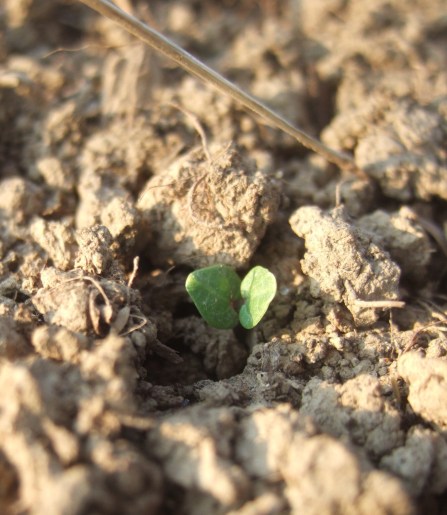 I wondered at the time if those words came straight from the liturgy of the Greek Orthodox Church, to which the family belonged; for each word seemed to me to bear mysterious promise–like the perennials in Nancy’s garden. We look for the eternal spring. Those are the two things I remember from that season following her death: the silence of working in her garden, and the simple goodness of her husband’s graveside words. Not gaudy or extraneous or saccharine, those words bound up pain and longing and faith at once, and I have carried them with me ever since.
In this new year, may we be present with each other, holding one another in silence, with love, with the goodness of sacred words. May we find solace in the seasons of this beautiful world, and in the wonder that bids us look beyond the brittle stalks of winter.
Peace,
Kim
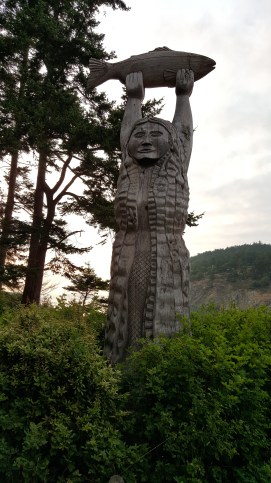 High on the cliffs of Rosario Point above Puget Sound, Ko-Kwal-alwoot stretches out strong arms to hold a salmon against the sky. Her
 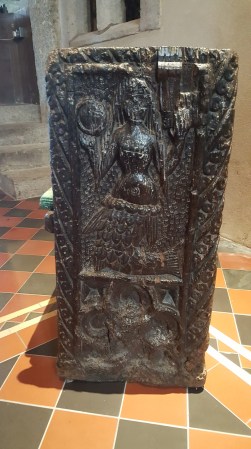 In Cornwall the rugged coastal trail winds into the tiny village of Zennor, where 6th Century Christians established the St. Senara church. Past needlepoint kneelers an ancient wooden chair depicts a mermaid lifting her bare arms.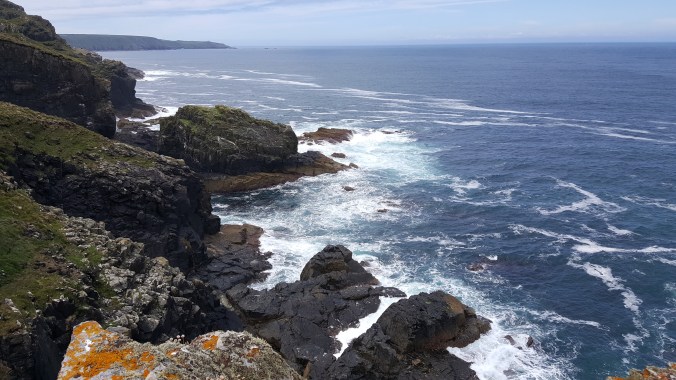
 Through all sorts of weather and almost daily in the summer, my family made the short trek to Crane Beach, a glorious four-mile sand beach and estate. We’d park the car, freight ourselves with towels and pails, shovels and sunglasses, and amble over the dunes. On the far side of those shifting mounds, we’d find the closest thing to infinity I knew. The Atlantic. With a few sailboats tacking at the horizon, and (on clear days) Maine’s Mount Katahdin a hazy bump, it was an immensity so searingly beautiful, it was a hair’s-breadth from pain.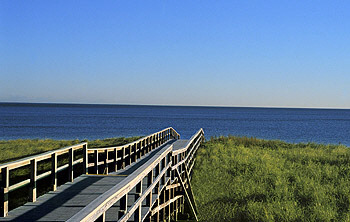
 Each Holy Hour