Recently a friend invited me to lead a training on vocation for young adults. “Thanks for thinking of me,” I accepted the invite, “I’d love to.”
Love to? Maybe.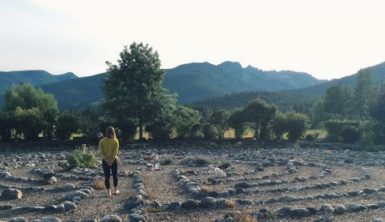
For me, vocation–the why that drives what I do — is a word full of shifting shadows. It’s a relentless companion that plucks at my elbow, eats at my board, sleeps when I sleep, rises when I rise. It’s alternately the draft upon which my heart soars and the hollowing wind that scours me empty. It’s a prize and a punishment.
Nearly eighteen years ago, Tim and I moved to Montana from the Boston area. We wanted to start our marriage on our own terms, away from the pace and pressures of the east coast. Though we’d never stepped foot in the state, we’d gathered ideas about Montana like wild yeasts caught from the air. Two weeks after our wedding, we packed a moving truck and drove across the country.
In those first years, we rented a small house on the Flathead Reservation, started making soap in the basement as a lark, and completed graduate degrees for our inevitable decampment back East. “Come visit us,” we widely broadcast to friends and family, “this is our last year here.”
Then our first son came. Still, we reasoned, after one more year, we would go. Then our second son arrived. A family now, we considered where we wanted to raise children. Montana’s rivers and mountains, its famous big sky and slow drifting days had gotten ahold of us. How could we leave?
We didn’t. Tim threw himself into turning our basement soap-making operation into a business that could sustain our family. And to support the eighty-hour weeks those early years of building a business demanded, I stayed home with our boys.
One day, shortly after the birth of our second son, I wove through the grocery store, pushing both boys in the cart. I bumped into one of my philosophy professors–a brilliant, hard-driven man– with whom Tim and I had both taken classes. We had loved every minute of his seminars, picking over the bones of modernity. He’d championed our plans to head back East for more grad school. That day, in the grocery store, as I tried to keep my toddler from climbing out of the cart, he asked me, “Why are you still in Montana? You’re wasting yourself here.”
The truth of those words struck me. I’d fallen out of the sphere where my mind could maintain the iron-sharpening-iron edge of academics. At home with two young children, I was out of the camaraderie and sense of accomplishment of the workforce. The losses were real.
But in another — equally true — sense, I was gaining myself, gaining myself in a quieter, harder way. We’d moved to Montana to live on our own terms, and now I was going to have to dig deep and lean into those terms. I couldn’t use the ready-made handhold of a career to lift my life.
Researcher and storyteller Brene Brown often talks about our tendency to “hustle for our worthiness.” Through pleasing and performing, we chase a sense of self. Even though I know in my bones that as a child of God, no amount of “doing” can add to my essential worthiness, I still find myself trying to earn this inheritance.
I believe we each live our own variants of the basic question: What am I here for? Entangled with ancillary issues like ego, status, failure, fulfillment, shame, hope, becoming, I find this question impossible to get a hold of; one bit snakes out just as I get the lid on the opposite corner.
“Discovering vocation does not mean scrambling toward some prize just beyond my reach but accepting the treasure of true self I already possess.” Parker Palmer writes in his book, Let Your Life Speak. My years in Montana, my years of “wasting myself” and gaining myself have been a decades-long lesson in learning not to scramble.
“Love, share, engage,” Kim writes in this week’s Consider. “These are the superhero tasks of our lives.” Egos scramble. True selves love, share, engage. Indeed this is hard and heroic work.
There is an old Hasidic tale that Martin Buber records in this way, “Before his death, Rabbi Zusya said, ‘In the coming world, they will not ask me: “Why were you not Moses?” They will ask me: “Why were you not Zusya?”’
In the shifting shadows and lights of my life, I’m discovering what it is to be me. Not Moses, not Zusya, just me.
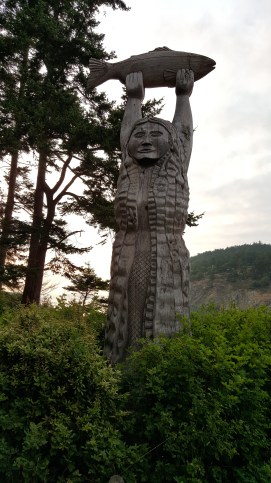 High on the cliffs of Rosario Point above Puget Sound, Ko-Kwal-alwoot stretches out strong arms to hold a salmon against the sky. Her
 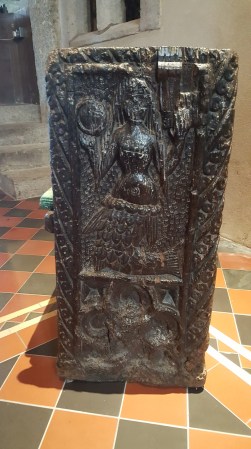 In Cornwall the rugged coastal trail winds into the tiny village of Zennor, where 6th Century Christians established the St. Senara church. Past needlepoint kneelers an ancient wooden chair depicts a mermaid lifting her bare arms.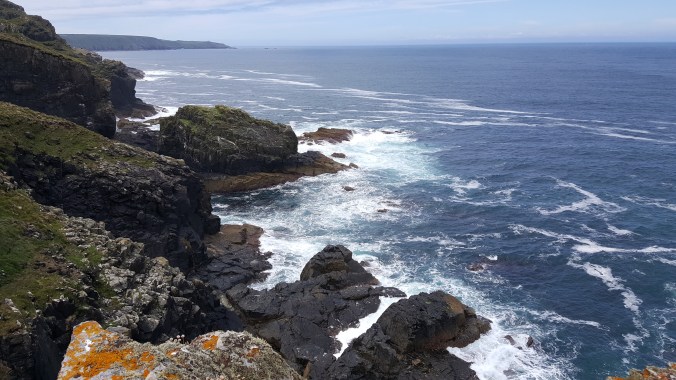
 Seventeen years ago, as Tim and I returned from our honeymoon in Maine, we spent the drive memorizing a W.H. Auden poem. In Camden, I’d picked up a hardcover collection of Auden’s work and, as we drove, I leafed through its pages until coming to
  Years ago, my husband immersed himself in the art of drystone-stacking. To understand the romance, travel to England (or New England) and stand beside one of those ubiquitous low stone walls that ramble across fields and over hills. The farmer who built those walls not only wanted to keep sheep from danger–the work evidences the soul of a poet. Not one stone is out of place; the whole has stood for a century or more. If you feel moved by this almost beyond comprehension, you may understand my husband’s obsession.
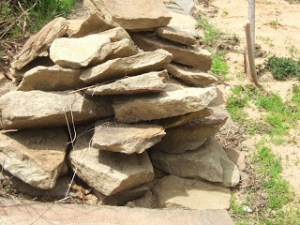 s her child. Then he groaned under their weight, heaving each into place.
 Like my husband’s stone-stacking, this is patient work. It is I who must heave each stone into place in this nitty-gritty work of soul-building. In the silence of suffering, in the greatness of joy, in every small choice I make or word I speak, I am constructing my own identity. If the stones of my becoming are hidden, half-buried in the woods, will I have the courage to unearth them, claim them for my own?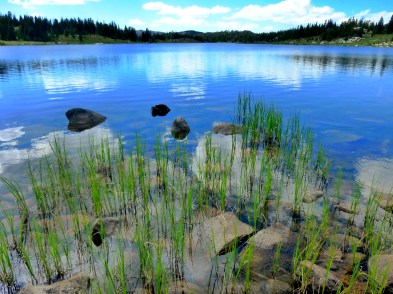
 h Holy Hour, a project for wonder, I admit to myself that my recent preoccupation with the many “ticks on the to-do list” that Lindsay described in her meditation has had nothing to do with encountering wonder. It’s not that I haven’t enjoyed moments of loveliness as I’ve waded through a thick morass of details of building a new website and content. Even in the thicket of logistics, even as I clawed my way up the steep learning-curve of technology, I’ve found time to hug my kids, take in our blooming cherry tree, stand hushed and awed over a nest of newly hatched chickadees.

 Each Holy Hour