Consider: The Wonder and Wound of this World

Dear Friends-

Yesterday the dog and I went on our favorite run.  For half an hour before I laced my shoes, I walked around moaning, “I don’t want to go.  Don’t make me go.”  There was no one “making” me go, unless you count the way Phoebe paced behind me, showing the “great red tear that makes us so sorry for noble dogs,” as J.M. Barrie calls it.  At last, with what seemed incredible mental effort, my shoes were on, my excuses over and we were padding out the door.  Predictably, within the first 400 yards, I wondered what all my fuss had been about.   
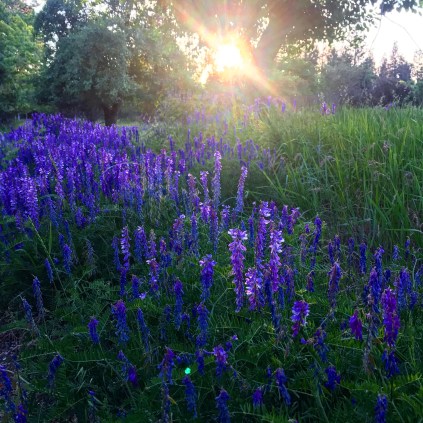
It was impossibly beautiful out there.  In the cooler, shadowy places, the hillsides were blue tongues of lupine, red sparks of Indian Paintbrush.  And in one spot, as I rounded a tight corner, I startled a flock of finches.  They flurried up, a chittering cumulous.  First a few.  Then more and more.  Until scores had burst from cover in the lupine, wings glinting in the low sun, and disappeared into the dark shadows of a lone ponderosa.  I felt over-awed by the sight, filled with a glad in-rush, new-born.  And yet in the same moment, something snagged my heart, that thing we call “a pang,” that sense beauty beheld is passing even as we encounter it.

“For to come upon warblers in early May

Was to forget time and death:

How they filled the oriole’s elm, a twittering restless

cloud, all one morning,” —Theodore Roethke, North American Sequence

I love the beauty in these lines from Roethke.  But I don’t believe them.  Warblers in May or finches startled from among the lupine do not make one forgetful of time’s passage.  They do not obscure the dark stile at the bend in the road.  Despite his statement to the contrary, I don’t for a moment think Roethke forgot these companions, else why bring them up?  Beauty is twined with loss, inseparable.

Every shiver of joy has a pull of loss in it, a rip in the seam. I can catch the glorious up-well of gladness.  But I can’t keep it.  Like the finches, it glints gold for a moment then disappears into a bank of shadow.

“Joy’s trick is to supply

Dry lips with what can cool and slake,

Leaving them dumbstruck also with an ache

Nothing can satisfy.”  – Richard Wilbur, “Hamlen Brook”

Richard Wilbur gets it right.  It is the signature trick of joy to both slake and leave behind an unsatisfiable ache.  Like a koan that defies the mind’s desire to parse and explicate, the aftereffect of joy is paradox.  In the middle of the finch storm, I had a deep sense of having been met and having been left.  Filled and emptied.  At home in the world and an exile from my heart’s true homeland.  I’m straining here, which is why the wiser Wilbur used “dumbstruck” and avoided the muddle.

We are made for this world.

We are not made for this world.

Can both of these be true?

At every turn, consciousness tugs us in both directions.  This wonder and wound is a birthright that, however many steps we take, we can’t outrun.

Here’s to cultivating wonder,

–Lindsay

P.S. We would LOVE to send you a little Each Holy Hour through the post office.  Just email us at eachholyhour@gmail.com with your mailing address and we’ll send you a personal message on one of our beautiful postcards. Just a bit of love from us to you.

P.P.S.  Last week’s Consider prompted some discussion on the Back Page about our faith journeys.  Pour a cup of tea and enjoy the meander.
The Why that Drives

Recently a friend invited me to lead a training on vocation for young adults.  “Thanks for thinking of me,” I accepted the invite, “I’d love to.”

Love to?  Maybe.

For me, vocation–the why that drives what I do — is a word full of shifting shadows.  It’s a relentless companion that plucks at my elbow, eats at my board, sleeps when I sleep, rises when I rise.  It’s alternately the draft upon which my heart soars and the hollowing wind that scours me empty.  It’s a prize and a punishment.

Nearly eighteen years ago, Tim and I moved to Montana from the Boston area.  We wanted to start our marriage on our own terms, away from the pace and pressures of the east coast.  Though we’d never stepped foot in the state, we’d gathered ideas about Montana like wild yeasts caught from the air.  Two weeks after our wedding, we packed a moving truck and drove across the country.

In those first years, we rented a small house on the Flathead Reservation, started making soap in the basement as a lark, and completed graduate degrees for our inevitable decampment back East. “Come visit us,” we widely broadcast to friends and family, “this is our last year here.”

Then our first son came.  Still, we reasoned, after one more year, we would go.  Then our second son arrived.  A family now, we considered where we wanted to raise children.  Montana’s rivers and mountains, its famous big sky and slow drifting days had gotten ahold of us.  How could we leave?

We didn’t.  Tim threw himself into turning our basement soap-making operation into a business that could sustain our family.  And to support the eighty-hour weeks those early years of building a business demanded, I stayed home with our boys.

One day, shortly after the birth of our second son, I wove through the grocery store, pushing both boys in the cart.  I bumped into one of my philosophy professors–a brilliant, hard-driven man– with whom Tim and I had both taken classes.  We had loved every minute of his seminars, picking over the bones of modernity.  He’d championed our plans to head back East for more grad school.  That day, in the grocery store, as I tried to keep my toddler from climbing out of the cart, he asked me, “Why are you still in Montana? You’re wasting yourself here.”

The truth of those words struck me.  I’d fallen out of the sphere where my mind could maintain the iron-sharpening-iron edge of academics.  At home with two young children, I was out of the camaraderie and sense of accomplishment of the workforce.  The losses were real.

But in another — equally true — sense, I was gaining myself, gaining myself in a quieter, harder way.  We’d moved to Montana to live on our own terms, and now I was going to have to dig deep and lean into those terms.  I couldn’t use the ready-made handhold of a career to lift my life.

Researcher and storyteller Brene Brown often talks about our tendency to “hustle for our worthiness.”  Through pleasing and performing, we chase a sense of self.  Even though I know in my bones that as a child of God, no amount of “doing” can add to my essential worthiness, I still find myself trying to earn this inheritance.

I believe we each live our own variants of the basic question: What am I here for?  Entangled with ancillary issues like ego, status, failure, fulfillment, shame, hope, becoming, I find this question impossible to get a hold of; one bit snakes out just as I get the lid on the opposite corner.

“Discovering vocation does not mean scrambling toward some prize just beyond my reach but accepting the treasure of true self I already possess.”  Parker Palmer writes in his book, Let Your Life Speak.  My years in Montana, my years of “wasting myself” and gaining myself have been a decades-long lesson in learning not to scramble.

“Love, share, engage,” Kim writes in this week’s Consider. “These are the superhero tasks of our lives.”  Egos scramble.  True selves love, share, engage.  Indeed this is hard and heroic work.

There is an old Hasidic tale that Martin Buber records in this way, “Before his death, Rabbi Zusya said, ‘In the coming world, they will not ask me: “Why were you not Moses?” They will ask me: “Why were you not Zusya?”’

In the shifting shadows and lights of my life, I’m discovering what it is to be me.  Not Moses, not Zusya, just me.

Consider: To Save the World

Dear Friends,

On Sunday evening, my girls came home from their neighborhood adventures with another stray chicken–the second in as many weeks.  My daughter, Beatrix, stroked the dense black and white feathers and announced, “We’re calling this one Pepper.”  Just then our neighbor returned from an emergency trip to see his dying father, and as his family drove their car slowly into their driveway, all chaos broke loose.  The street suddenly exploded with a loose chicken, children, dogs, and one cat, all tearing madly after each other.

I felt half-amused, half-sorry for our grieving neighbors as they returned to the melee of activity, but later, thinking back on how the street turned out to gather around them as they unpacked the car (one neighbor brought a pitcher of G&Ts), I concluded that it wasn’t an altogether bad way to come home.  From quiet sorrow into the chaos of life: animals and children, neighbors clicking their plastic cups together, murmuring, “I’m sorry about your dad. . .” and “We’ve got dinner if you want to come over.”

This past week brought more bad news: a new round of terrorist attacks in London and another step back from hard-won cooperation needed to sustain the earth.  This morning as I drove my daughter to school, these mighty fractures, combined with my own personal griefs, descended like a great weight.  I felt tears well up as I listened to the radio–of all things, that pop song by Charlie Pluth that goes, “Superman ain’t got nothing on me.  Come on, I’m only one call away.”

Swift self-analysis followed:  Sentimental drivel — making me weepy– WHY?

I admit to having a penchant for superhero movies.  This past weekend, when Wonder Woman charged across the front line to free a village, I was sprinting with her, wrist deflectors up, every righteous muscle tensed.  And this morning as I thought of the hurting people in this world and in my life, I wanted to pull out my sword.  Come on, I’m only one call away.

But even the superhero movies these days–at least the good ones–are marked by this complexity: even with superhuman powers, you can’t save the world.  Most of the time, you can’t even save the people closest to you.  We are weighted; we want superheroes.  But as the iconic Flaming Lips song Waiting for Superman says, what we carry is “just too heavy for Superman to lift.”

Superheros have always been part of human mythology.  When we slam up against our own limitations, we often scan the sky, looking for salvation.  But it is our hands that must shape this world for good, our feet that must trod the forgotten places.
“And while I don’t expect you to save the world,” poet and true wonder-woman Nikki Giovanni once said, “I do think it’s not asking too much for you to love those with whom you sleep, share the happiness of those whom you call friend, engage those among you who are visionary.”  Love, share, engage.  These are the superhero tasks of our lives.

Here’s what I can do this week:  throw open my door and join the chaos, chase a chicken and say “I’m sorry,” despite the fact that those words just don’t seem like enough.  I can stand alongside, tell the truth to the people in my life, actively love my neighbor.  And when the time is right, I can march.  I’m no Wonder Woman–but I am full of wonder, and the light inside compels me to pursue peace and healing.  This is our shared, daily, unspectacular work, done one moment at a time, each holy hour.

Here’s to cultivating wonder,

–Kim

P.S. I hope you won’t miss Lindsay’s reflections on Friday’s blog –I always look forward to capping a busy week that way! And please note–if you’d like blog posts delivered to your mailbox as well, you can hit the “follow” button for weekly deliveries.

P.P.S.  Check Facebook and Instagram this week for something REALLY LOVELY.  We’re thrilled to be able to send some EHH to your actual, old-school mailboxes–handwritten, addressed just to you. And thank you again for being part of this community!o

The Limits of Your Longing

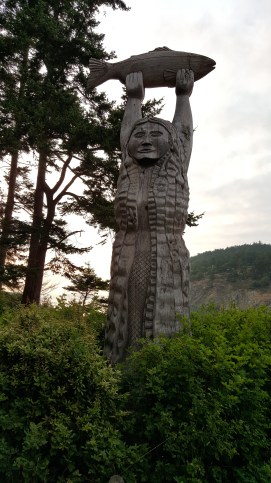
20150710_201308High on the cliffs of Rosario Point above Puget Sound, Ko-Kwal-alwoot stretches out strong arms to hold a salmon against the sky.  Her story pole, carved from a hulking 30’ X 5’ cedar log, tells the Samish Indian myth of a maiden who agrees to marry The Sea to save her people from starvation. Despite her father’s objections, she walks wholeheartedly into the cold salt water, and The Sea–honoring his promise–releases salmon the Samish so desperately depend on.   
You don’t need to search far to find them: myths of the eternal calling to the temporal, divine spirits falling in love with the mortal, and the mortal responding with abandon.  I thought of this as I read Lindsay’s last Consider, as she described the way her spirit swelled and leapt out into the wild waters of the Atlantic.  All ancient cultures bear witness to this longing.

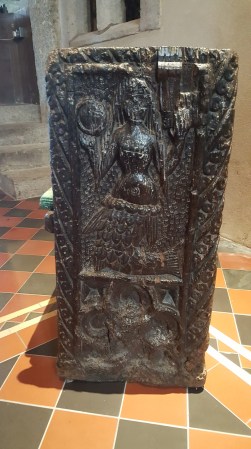
20160621_165438In Cornwall the rugged coastal trail winds into the tiny village of Zennor, where 6th Century Christians established the St. Senara church. Past needlepoint kneelers an ancient wooden chair depicts a mermaid lifting her bare arms.  Legend has it that she wandered from the wild turquoise sea in search of chorister Matthew Trewhellen, whose voice had been borne to her by the wind.  Trewhellen left the familiar–friends and hearth and garden–and dove beneath the waves forever. The call: Come.  The response: I abandon myself completely.
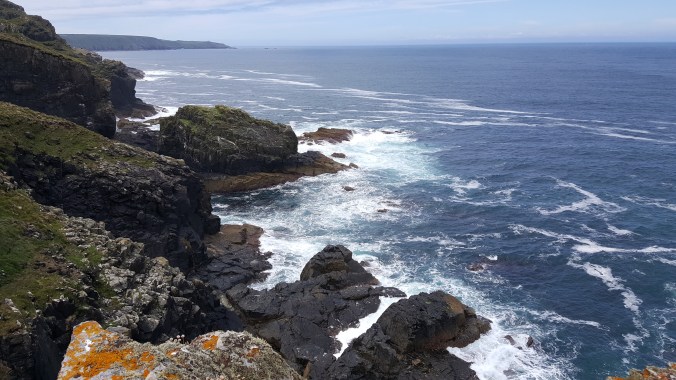
Who among us have not felt this keening?  Deep calls to deep in the roar of your waterfalls.  All your waves and breakers have swept over me.  This Psalm has captured me since I was a child.  The eternal calls my name and I long to throw myself off the edge into something greater.

It’s not a call to comfort and easy solace.  Summers at the Atlantic, I remember being caught by a wave, rolled into a swirl of green, pulled by the current, pounded by the surf.  The ocean spat me onto the sand; I gasped for breath.  Then I wiped the salt from my eyes and went back in.

This is a dangerous summons.  Jump in knowing there’s no guarantee you won’t be destroyed.  But you will be remade.

Ko-Kwal-alwoot walks out over smooth stones.   Above her head, osprey call, scanning the water for their next meal.  Behind her, cedars, hemlocks, madrones rise; at her feet, spreading out cold and grey, the waters of Puget Sound.  As she reaches to draw out a shellfish, a hand grasps hers.  “Don’t be afraid,” a voice says.  She must join the Spirit, for her people are starving.  She must plunge into the freezing depths, for there is no other way.  When she visits her family again, she will be changed–damp air will linger in her wake, her hair will wave like kelp.  She will miss the sea; back to the sea she will return; her home will never again be what it once was.

With all our great poetry, music, art, we are no nearer to adequately finding the words to domesticate this longing.  Perhaps few writers have done so well as Rilke:  “God speaks to each of us as he makes us,” he writes, “then walks silently out of the night./These are the words we dimly hear:

You, sent out beyond your recall,

go to the limits of your longing.

Embody me.

Flare up like a flame

and make big shadows I can move in.

Let everything happen to you: beauty and terror.

Just keep going. No feeling is final.

Don’t let yourself lose me.

Nearby is the country they call life.

You will know it by its seriousness.

Give me your hand.

Ko-Kwal-alwoot extends her hand, sinks into the slate-grey waters.  The young chorister scrambles through thrift and foxgloves, his back to the dark sleeping village, throws himself from the cliffs.  From the wild depths, a summons.  Go to the limits of your longing.  Nearby is the country they call life.  Give me your hand.

20160621_121912

_Postscripts__

-Please check out the beautiful story of the Samish Maiden for yourself, as told by Charlie Edwards to Martin Sampson in 1938.  And if you ever find yourself at Deception Pass near Whidby Island, WA, don’t miss the story pole at Rosario Point.

-Keep stopping by The Back Page for more behind-the-scenes.  Thank you!

Photo Credits:  Martin Cockroft

Consider: Past the Headlands

Dear Friends,

Each Holy Hour is one month old! Like a newborn opening her eyes to the world, Kim and I are in a haze of astonishment at the response we’ve received. Your comments, shares, personal messages and feedback have meant a lot to us. Thank you for letting us into your lives. It is truly an honor to journey with you.

This week, as I watch my kids near the close of another school year and anticipate the long, lazy days of summer ahead, I’ve been thinking about my own childhood. My hometown in coastal New England is a postcard of colonial clapboards and blue ocean. Through all sorts of weather and almost daily in the summer, my family made the short trek to Crane Beach, a glorious four-mile sand beach and estate. We’d park the car, freight ourselves with towels and pails, shovels and sunglasses, and amble over the dunes. On the far side of those shifting mounds, we’d find the closest thing to infinity I knew. The Atlantic. With a few sailboats tacking at the horizon, and (on clear days) Maine’s Mount Katahdin a hazy bump, it was an immensity so searingly beautiful, it was a hair’s-breadth from pain.
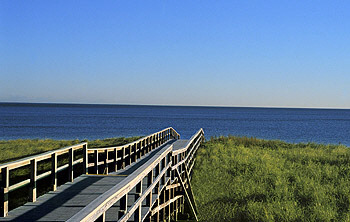
The Atlantic nurtured all my budding devotional impulses. Like the Divine, it was unboundable, unknowable, and yet right here, spending itself on the sand, lapping my shins. Changeless yet always changing, it followed its own rhythms of waves and tides, a pattern as old as Earth.

In my family, we were earnest Sunday-school attenders. While my friends zipped around bays and coves in bowriders, I spent Sundays in the pews of First Presbyterian. Often, on our hard benches, we traveled deep into questions of faith and meaning, casting lines from the bow through prayers and hymns, stories and practices.

But the Atlantic preached another kind of sermon. Wordless in its exhortation, speechless in its exegesis, it made me feel the thing we mean when we say, “my heart leapt up.” Solemn elation, deep-fed joy, something at the far-border of my senses, stirred in me.

“Exultation is the going/Of an inland soul to sea, —” writes Emily Dickinson. “Past the houses, past the headlands/ Into deep eternity!” As a child, I thought this poem was written for me. It seemed so intuitive to my experience, I felt proprietary regard for it. It bespoke the way the Atlantic pulled the tide of my heart toward something deeper. It suggested that all the human habitations – the propositional truths and earnest homiletics in which we usually trafficked – were just the beginning of the adventure. Beyond these headlands, deep eternity called.

I’ve never gotten over that call.

Every trip to Crane Beach ended with gathering up our pails and shovels, shaking sand from shoes, traipsing back over the boardwalk. We’d drive home and pack everything away, hang towels on the back porch. I’d brush my salt-tangled hair and arrange a few shells on my shelf, living in the afterimage of the blue, endless Atlantic, and waiting again for this inland soul to go to sea.

Here’s to cultivating wonder,

–Lindsay

p.s. On Friday, Kim will continue the conversation on our blog. Check it out and leave us your thoughts.

p.p.s. We’ve launched a new page on eachholyhour.com. The Back Page is our way to honor the messiness of providing thoughtful content. It chronicles some of the behind-the-scenes pitfalls and levity we bring to this work.

What Remains

Seventeen years ago, as Tim and I returned from our honeymoon in Maine, we spent the drive memorizing a W.H. Auden poem.  In Camden, I’d picked up a hardcover collection of Auden’s work and, as we drove, I leafed through its pages until coming to “As I Walked Out One Evening.”  The poem – fitting it seemed for a honeymoon – begins with two lovers strolling along the Thames.  Reaching a bridge, the lovers linger (as lovers do) to pledge and proclaim their undying love.
Sweet, sentimental stuff, these words, and on-point for two kids driving through coastal Maine with the “Just Married” paint still visible on our car’s rear window.

Then without warning, Auden’s poem veers sharply.

Into the midst of the lovers’ disclaiming, suddenly “all the clocks in the city/ Began to whirr and chime. ”  On and on the clocks go with their tolling, gainsaying the lover’s optimism.  Through the next several stanzas, Auden relentlessly compiles the ways time works its many disappointments, piling up losses in its wake.  “Into many a green valley,” he notes, “drifts the appalling snow.”

These deft lines steer toward a single question: What can stand the relentless onslaught of time?  The clocks’ insistence consigns everything to dissolution.  Their tolling indicts love’s pretensions to escape unmarred.  Happy stuff for a honeymoon, yes?

In this week’s Consider, Kim writes about sorrow padding along beside her amid spring’s glories.  “How do I make peace with a reality where beauty and travesty stand shoulder-to-shoulder?” she asks.

This has been a week of devastating news.  A week in which we’ve seen another place claim its spot on the sad and terrible litany we repeat: Paris, San Bernadino, Orlando, London, Brussels, Manchester.

Of course, loss isn’t only in such epic tragedies.  As I watch the painful dissolution of a friend’s marriage, as I watch my widower neighbor try to get a handle on his days, I know we are deep in the appalling snow.  And, if we probe our own hearts, who of us cannot touch some vein that seizes with sorrow?

“Sorrow is so woven through us, so much a part of our souls, or at least any understanding of our souls that we are able to attain, that every experience is dyed with its color.  This is why, even in moments of joy, part of that joy is the seams of ore that are our sorrow,” Christian Wiman writes in his essay “Sorrow’s Flower.”

As Wiman suggests, I don’t think there is peace to be made with the reality of beauty and travesty standing shoulder-to-shoulder.  Rather this is the animating tension of our lives.  As Auden shows, even in a blessed life where things are going well, the clock is still ticking away the moments, is still stepping us closer to the tragedy that will stagger us.  The lovers’ blissful moment by the river (and indeed every moment, blissful or not) is haunted and compromised by this reality.  And isn’t that reason enough for sorrow to run its vein right through us?

What do we do with such a reality?  Despite the dismal state he has descried, Auden will not leave us comfortless.  He enjoins the reader with two incredible stanzas:

‘O look, look in the mirror,

O look in your distress:

Life remains a blessing

Although you cannot bless.


‘O stand, stand at the window

As the tears scald and start;

You shall love your crooked neighbour

With your crooked heart.'


Through the years, these words have never run dry.  The hope they contain is not starry-eyed — rather wrested from the muck, with the dirty fingerprints of that struggle still upon it.  There is no way around this place where sorrow and loss compromise your joys.  One must go through.  And as we do, we find the incredible, mysterious truth that, however compromised we are, life remains a blessing.  From this new-found place, “You shall love your crooked neighbour/ With your crooked heart.”

Late this summer, Tim and I will have our eighteenth wedding anniversary.  Like Auden’s lovers, we’ve had plenty of moments that have sung out with promise.  And we’ve had plenty which would  be better characterized by his line, “in headaches and in worry, vaguely life leaks away.”  Such are the conditions of being.  And you know what, friends?  However deep in the appalling snow, however much the clocks toll time’s passing, however crooked I find myself and my neighbour, Auden’s humble words abide.  They run on and on like the river.  “Life remains a blessing.”

Consider: Making Peace with the Reality of Beauty & Travesty

Dear Friends:

Last weekend in the Pacific Northwest, a curtain of cloud lifted to reveal the Olympic Mountains rising over an inscrutably blue Puget Sound. Rhododendrons burst into giddy bloom. By Sunday evening, loveliness had worked its way into my bones.

So in the small hours of Monday morning when I suddenly woke from a bad dream, I felt betrayed. Like seeping ink, sadness swirled in me and spread. As I got out of bed, it rose and followed me into the sunshine of a new morning.

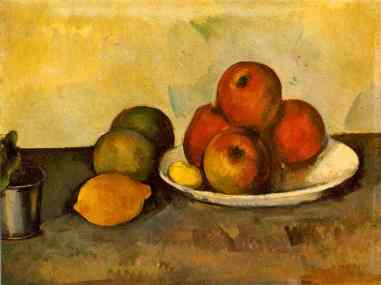
Later, a pot of tea steeping under the cozy, I picked up a slim volume of excerpts from Rilke’s letters, detailing his encounter with a Cezanne exhibition. Cezanne, Rilke believed, exemplified a revolutionary shift away from idealized images to “plainspoken fact.” Cezanne’s paintings do not only change the way we think about art, Rilke contends, they change the way we see. “Something horrible, something that seems no more than disgusting, is,” Rilke writes, “and shares the truth of its being with everything else that exists.”

Rilke, in this beautiful spring, you break my heart. How do I make peace with a reality where beauty and travesty stand shoulder-to-shoulder?

Truthfully, I often long to turn my head from unpleasantness in the world. On a trip to the UK last summer, I found a Tesco reusable shopping bag printed with the merry message, “Fill me up with lovely things again and again!” I hauled that bag all over England, grinning ear to ear. For who doesn’t want to be filled with lovely things?

But to participate honestly in this world and indeed to tell the truth with my life, I must accept, and step right into the middle of, suffering. I must hold space for the sorrows and losses that bloom right among the beauties and joys. For to refuse life its complexity–to deny suffering and ‘ugliness’ – leads to a cheapened, sepia-tinged view of the world. And sentimentality, while easy, is pernicious.

The artist is not “permitted to turn his back on anything,” Rilke writes. To do so, he intimates, is to lose the whole, to relinquish what it means to be human. So today, I will not turn my back on the sadness that plucks at my elbow. As Rilke says, “it shares the truth of being with everything else that exists.” Here, this cup of tea at my side, this dog napping under the maple tree, this lingering sadness, all of it I acknowledge. All of it goes in my Tesco bag, filling me up again and again.

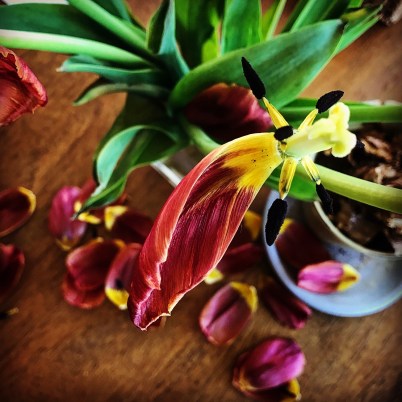
tulipFriends, who are the artists who give you the courage to embrace this complicated world of ours? Please share with us by commenting either at our site, on Facebook, or on Instagram. And thank you for joining us. You all mean so much to us.

Here’s to cultivating wonder,
–Kim

Soul-building? It’s Nitty-Gritty Work.

Years ago, my husband immersed himself in the art of drystone-stacking.  To understand the romance, travel to England (or New England) and stand beside one of those ubiquitous low stone walls that ramble across fields and over hills.  The farmer who built those walls not only wanted to keep sheep from danger–the work evidences the soul of a poet.  Not one stone is out of place; the whole has stood for a century or more.  If you feel moved by this almost beyond comprehension, you may understand my husband’s obsession.
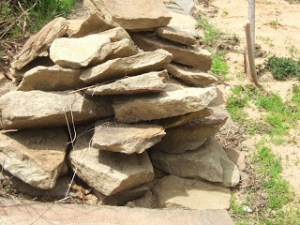
The lore surrounding this time in our family’s life is epic.  My husband constantly scanned ditches, neighbor’s yards, even graveyards, for stray stones.  Once spotted, he’d go to what I thought were ridiculously great lengths to secure them, trampling into the dense Pennsylvania woods through brush and trash to unbury stones that he would load into our old pickup truck.  At home, I watched in some consternation as he ran his hands over each stone, considering them as carefully as a parent studies her child.  Then he groaned under their weight, heaving each into place.

As each stone found its home, my consternation turned to wonder.  Morning turned to afternoon and ripened into twilight.  He seemed to be completely unaware of time passing, or of our children needing dinner–or anything.  He was locked in silent conversation with the stones.

Stones don’t want to be trapped in mortar, he told me.  As time passes, they need to be able to expand and shift.  That will make the wall stronger.  If built right, he said, it will last longer than we will.

Finding exactly the right place for each stone is crucial.  The process can’t be rushed or your wall will topple. I watched from the window as he intuited the perfect place for each stone according to their shapes.  When he was finally done–days, weeks later–the wall was beautiful and strong, and looked as if it had always been.

I feel drawn to the souls of people I love and admire, and it’s easy sometimes for me to forget that their magnetic, quiet beauty has been crafted painstakingly, stone by stone.

In this week’s Consider, Lindsay unfolded Keat’s idea of soul-making.  While the concept of soul is shot through my mystery and has much to do with gift, the actual business of soul-making is practical, everyday work.  I can take steps to build my soul into a beautiful, strong thing or I can give up and hope it will be done for me.  The choice is mine.

Like my husband’s stone-stacking, this is patient work.  It is I who must heave each stone into place in this nitty-gritty work of soul-building.  In the silence of suffering, in the greatness of joy, in every small choice I make or word I speak, I am constructing my own identity.  If the stones of my becoming are hidden, half-buried in the woods, will I have the courage to unearth them, claim them for my own?
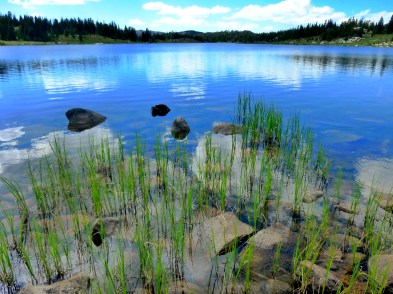
It is comforting for me to remember that this business of soul-building is not a wholly solitary venture.  Some stones just weigh too heavy for me.  Will I have the vulnerability to ask for help from my fellow stone-builders?

For as Keats says, this world is a vale of soul-making.  I do not work alone.

Photos:  Lake District 2016.  From the hillsides (at top) to the walls (left, above).  This is one of many photos my husband took of stonewalls during our trip to England!

Consider: The Essential Work of Soul-Making

Dear Friends,

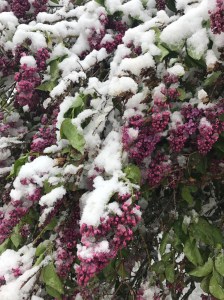
This mid-May morning we woke to a surprise: every tree bent beneath a tremendous weight of spring snow. In the early dawn hours, my husband hefted a pole and riffled through the plum and mountain ash, the lilac and aspen, relieving them of whatever burden he could. For some branches, it was too late. Full of yesterday’s blossoms, they littered the yard.
For some reason, as I looked on this unexpected conjunction of winter and spring, snow and blossom, I thought of John Keats’ descriptor of the world as “The Vale of Soul-Making.” This lyric phrase has something both sad and luminous about it. I hear in it Keats’ attempt to reconcile his world of frailty and illness with the limitless “sparks of the divinity” he intuited in himself and others. Keats was not alone in feeling this tension between two true things: we are limited beings in time, and yet, always some intrinsic part of us opens into eternity. Every day, we encounter this paradox.

Keats’ words help orient me to what’s really at stake within the granular moments of my day. The essential and holy work of soul-making is literally hidden in plain sight amid the choices and commitments of daily life, amid the harried morning routine, the second cup of tea, the momentary glance at finches pressing tiny footprints around the feeder.

It’s tempting, I think, to expect such cardinal work to have a little more pomp and pageantry to it, a little more signaling to pay attention. It doesn’t. This vale, as Keats calls it, is full of humble, forgettable, common things, and at times beset by unexpected snowfall. And yet, out of this swale our souls are being made.

I don’t know about you, but most of the time, I feel both rife with blossom and bowed with snow. Like the lilac outside my window, such are the conditions into which we must lean.

On Friday, Kim will be exploring this theme on our blog. Also, this Consider will be posted there with a comment section. As always, we’d love to hear your thoughts.

Here’s to cultivating wonder,
–Lindsay

Plumb Line

The dog and I are just back from a midday walk.  Now, she pants out a tale of the tennis ball she pursued through thicket and grove while I sit here, trying to hold myself within the afterimage of our outing.  Mid-May in my corner of Montana means the hillsides are studded with sun-yellow balsam roots, aspens wave newborn leaves, and choke cherry bushes are top heavy with their spires of blossom.  Literally, every step is a passage into something breathtaking.

In this week’s Consider, Kim writes, “Beauty awakens questions that have been sleeping within us.”  Today, as I walked through the incredible momentary show May had conjured, I didn’t so much think about this quote, as experience it.  I had no moment of lightning insight, no one great question rising.  Rather my on-going inward conversation dropped below all the edifice upon which daily life runs (appointments and errands, chores and checklists) and touched in with deeper, foundational ground.

It’s an astonishment really, this business of being here. We are here.  And we are aware of being here.  And we continually ask questions of this awareness to plumb the meaning of our being here. This is surely the miracle and gift of consciousness.  And its weight and wound.

While I walked just now, I knew that by next week the balsam roots would pale to straw.  In another week, they’ll be memory.  And yet, I am permitted to walk through their abundance now, to send the dog tearing through them, nose to the ground, living out her singular fixation on retrieval.  All of this is, as they say, here today gone tomorrow.  Yet it bespeaks something timeless.  Despite its fleetingness (and my own) it cracks the door on eternity.

A few years ago, my husband and I drove Going to the Sun Road through Glacier National Park.  This corkscrew of a drive, hewn to the side of a plunging valley, is truly a feat of engineering.  Yet the vast expanse of human ingenuity seems but a mote in this dizzying landscape.  We’d turned off the radio, opened the windows, ceased to talk.  It felt like the air those peaks passed between them was somehow older, deeper.  As we neared Logan pass, Tim broke our silence, “This place makes me want to be a better person.”

This and feature photo by Ken Cockroft

That’s just it.  Beauty plays upon some imprint so deep inside of us, we’ve nearly kicked over its traces in all our day-to-day shamblings.  But, these fugitive encounters invite something deeper, urge a communion we perennially crave.  Each time is an opportunity to send the plumb line down and see just how deep we go.  As for me, I hope to never hit bottom.