Consider: Calling Across the Lake

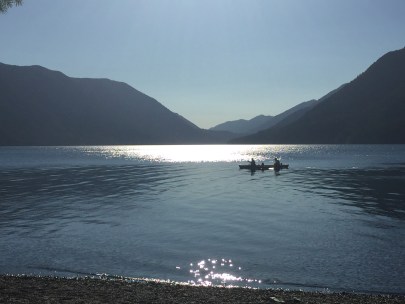
kayakSince moving to the Pacific Northwest, I have come to believe that nothing is better than “messing about in boats”–if those boats are kayaks.  I love that first pull away from shore, the transformation of clumsy land mammal to gliding waterbird.

Some months ago, I escaped the busyness of my life for a camp near Mt. Rainier.  More than anything, I hungered to be out on the lake alone.  I pushed out my kayak, paddled into deep water, and waited.  For what?  I think I wanted the lake to give me something, though I can’t tell you what it was.

The lake did not fulfill my overly simple quest for “peace and quiet.” The wind stirred the trees, birds cried, my paddle dipped into the water.  Inside my head, voices shouted and whispered and cajoled.  Still, I waited, as I often do when I enter into a wild place, for some kind of gift, some kind of salvation.

But as the saying goes, wherever you go, you are there.  Even in the midst of that expansive beauty on the lake, I felt the margins of myself keenly.  Again, I was the self-conscious human, standing outside, looking in.  Small, limited, cosmically alone, I waited.

I am–and you likely are, too–the man in Robert Frost’s poem, The Most of It, who stands at the edge of a lake and shouts.  What does he hope for?  A voice not his own, a voice to startle him out of his weary self.  What does he receive, coming back over the water?  An echo of his own voice.  He thinks he keeps ‘the universe alone,’ and in this echo-chamber, there is no escape.

Sound familiar?

“Some morning from the boulder-broken beach

He would cry out on life, that what it wants

Is not its own love back in copy speech,

But counter-love, original response.”

What saves him, with sudden, unsettling crash, is a mighty buck that pushes the water and scrambles to shore, “pouring like a waterfall,” then ploughs through the underbrush–and is gone.

What saved me that day out on the lake were the ospreys that circled high, crying, and then plunged down into the water to hook fish in their claws.  I pulled my paddle and let myself glide, absorbed in watching the birds dive and call.  For just a moment, the multitude of things that clamor for my attention died away in the stunning scene before me.

This world shakes me from myself again and again.  Some days, of course, my walls are simply too impenetrable.  But I keep calling across the lake, waiting for that encounter with the Other.  And all I have to do, most of the time, is show up.  Whether it’s pushing out a kayak or simply stepping out on my back porch, this world so often rises up with is own startling presence.

Peace,

Kim

P.S.  For a rather humorous behind-the-scenes glimpse of this week’s Consider, please visit The Back Page.

P.P.S.  We’d love to hear from you.  Please enter the conversation–suggestions for further reading, counter-readings of Frost’s poem–on Facebook or on the comments form on our blog. Or drop us a line.

Consider: All This Shining

Dear Friends,

I turned 40 this week, and in the midst of the lovely tumult of phone calls and texts, dinner with friends and well-wishes from many corners, my mother said something that crystallized my feelings about the day. “How did you get to be my age?” she asked.

I understood exactly what she meant. From a certain vantage point, there is a way in which time seems anything but linear. While days fly by, and years accumulate, the Self seems to somehow stand outside of time, to bend light in its own way. While I notice my kids growing up, my own discrete consciousness doesn’t age. My mind feels roughly the same as it did whenever I first tuned into its continuous stream. From this perspective, of course my mom and I are of one age.

A few weeks ago, I began teaching middle school language arts. “How do you know you are growing up?” I asked my eighth grade class as we launched our unit on personal narrative. Our school is K-8, and many of them have been enrolled since Kindergarten. “Look at you all!” I held up a picture of their Kindergarten class. “What did you care about back then?” The class was off and running. “Stuffed animals,” one said. “Remember how loooonng it seemed between each birthday?” another asked. “Sometimes I couldn’t tell the difference between imaginary and real.” “On the first day of school in Kindergarten I tried to dig a hole through the Earth.” “I remember thinking that if I tried hard enough I could really fly.” These eighth graders with their lanky bodies and changing voices, had memories tumbling out of them.

We read the Billy Collins poem, “On Turning Ten,” which ends with these memorable lines:

It seems only yesterday I used to believe
there was nothing under my skin but light.
If you cut me I could shine.
But now when I fall upon the sidewalks of life,
I skin my knees. I bleed.

“Now that you are older,” I asked my students, “what sidewalks of life have you skinned your knees against? What are the realities you bump up against?”

“We moved,” one student said, “and I had to start over with friends.”

My own son slyly piped up, “I used to believe in my parents.”

“Right, adults are fallible,” I nodded, adding that to the list on the blackboard. “You all have probably learned that by now.”

They laughed knowingly, these thirteen-year-olds pivoting on the threshold between childhood and growing up. I could almost feel their consciousness beginning to bend time out of shape.

Later, I thought about that Billy Collins poem again.  He’s right about one thing– there’s no denying the way we all bleed when we fall against life’s sidewalks.  Daily it seems, I watch my eighth graders skin their knees against the pavement of their tricky social navigations.

And yet, there’s all this shining.

Unlike the poem’s speaker, I still believe there’s light under my skin. It’s this quality my mother is speaking to when she asks, “How did you get to be my age?” There’s a luminous stream coursing through each of us and time bends in its current.

Peace,

Lindsay

Consider: Song in a Broken World

Dear Friends,

After a busy summer, Lindsay and I are settling back into school-year rhythms.  We’ve missed the practice of writing for Each Holy Hour and the camaraderie of exploring this good world with each of you.  We hope your fall routines are emerging with space for a cup of tea and a deep breath.  I wrote this reflection a few days ago, shortly after our summer ended in the sort of unexpected tragedy that marks all our lives.  Thank you for sharing this space with me.

It’s been a week since I watched my dog die, and today I am finding the business of living difficult. I am trying to summon my energy for tasks and goals. I am trying to make myself go for a walk, by myself.  Charley, our Jack Russell, was after all a dog, and I can live without a dog. But the truth is, I miss him terribly.

It doesn’t help that our sun glows red today from the fires devastating Washington and Oregon’s exquisite forests. Elsewhere, floods and hurricanes shatter livelihoods. As I watered my parched garden this morning, I pulsed with the ancient question: why do terrible things destroy good? Why does senseless violence pummel homes, devour lives, wreck hopes, and just last week, tear our beloved dog apart in front of my daughter Beatrix and my niece?

I haven’t been able to get the images out of my mind. As we walked home from soccer practice, a large, vicious dog appeared silently, took Charley in his jaws, and shook him until he died.  In the hours that followed, Beatrix kept sobbing, “Why did that have to happen?”

I don’t know, I don’t know, I’m sorry. It is the only refrain I can find in moments of tragedy.

What I see in this world is beautiful. What I see in this world is broken. What I know right now is sadness.

And yet. Last night, as Beatrix lingered over dinner, I suddenly thought of an old hymn we learned years ago at our Mennonite Church. Before I knew it, I was singing it out loud, locking eyes with my daughter.

My life flows on in endless song, above earth’s lamentation.
I hear the sweet, though far-off hymn that hails a new creation.
No storm can shake my inmost calm, while to that Rock I’m clinging.
Since Love is Lord of heaven and earth, how can I keep from singing?

Over the years, through bone-shattering tragedy that has destroyed people and places we loved with all our hearts, I have come back to that hymn. Since Love is Lord of heaven and earth, how can I keep from singing?

Today, once again, I hold both the reality of not-knowing, of grief, alongside this song my soul sings. It is a song shot through by the same sure joy I saw in our dog as he sprinted after a squirrel or snuggled next to Beatrix at the end of the day. It is the song that stirred us as a policeman laid his own jacket over Charley’s broken body.  It is the song of my sister quietly returning to scrub away the signs of brutality from the pavement.  It is a song I chose to hear, of being alive in a place where–despite everything–Love is Lord of heaven and earth.

Lindsay sent me an excerpt from Le Petit Prince a few days ago.

“Goodbye,” said the fox. “Here is my secret. One sees clearly only with the heart. Anything essential is invisible to the eyes.”

Thank you, friend of my heart, for those words. Today, though my heart aches, I choose to return again to what is essential:  great love, a world shot through by beauty and goodness. How then can I keep from singing?

Peace,

Kim

p.s. Join us on The Back Page for a discussion about summers, dogs, and new responsibilities.  We’d love to hear your summer memories and your autumnal hopes! (Spoiler Alert: Kim is getting to know a beautiful rescue dog and Lindsay is busy with students!)

p.p.s.  We’ve still got a stack of lovely “Each Holy Hour” cards.  Please let us know if you’d like to find one in your mailbox.  Just visit the “Contact Us” page at our website and send us your address.  There’s no obligation and your information is completely private–it’s truly a free little gift of wonder.