Diminished Things

Dear Friends,

Well, it’s happened early this year. The view from my window, normally a crisp mountain scene, is full of deep orange haze. Smoke casts a pall on everything. Even the lavender just beyond my office window and the bees doddering around its blooms have a burnished look.

Even though fire season is a regular part of life here in Montana, I still felt disappointed last week when I spotted a feathery plume rising on the far side of Lolo Peak.  Though many miles away, Lolo Peak feels like a neighbor. Whether I’m washing dishes or sipping tea at my table, this mountain, with its changing show of light and shadow, is a constant companion. I depend on its solidity and beauty like a boat depends on its mooring.

In the past few days, that thin line of smoke grew into a substantial cloud. This morning I woke to find the valley completely inundated. Lolo Peak is totally obscured. And my own horizon feels hemmed in.

Always, at the point when summer turns this corner, I reacquaint myself with Robert Frost’s poem The Oven Bird. The ovenbird, a warbler, is one of the few birds who trills his song in midday heat. Thus, Frost associates the ovenbird’s signature tea-cher tea-cher tea-cher with the idea that summer is passing away.  The “he” of this poem, is the ovenbird whose song calls up these realities:

He says the early petal-fall is past
When pear and cherry bloom went down in showers
On sunny days a moment overcast;
And comes that other fall we name the fall.
He says that highway dust is over all.

Like the chime of a clock, Frost’s ovenbird measures time.  Like smoke pluming up, it tells us summer isn’t here to stay.  As Frost’s bird chirps and warbles out these tokens of summer’s passage, Frost funnels the reader to a final haunting question:

The question that he frames in all but words
Is what to make of a diminished thing.

Phew.  It’s bracing, isn’t it?  What to make of a diminished thing?  This question rattles around with me, not just as smoke season presses in, but in a way that ramifies into other areas in my life. It’s an essential midlife question. It’s a question for times when a relationship has stung. Or when your body and health betray you. The world’s sleight-of-hand constantly delivers us beautiful things, then bruises them. We are forever having to ask ourselves what to do with diminishments. What will you do today, as the ovenbird warbles its song?

For me, I am going out among the lavender and the doddering bees to weed my garden. Later I will walk through smoky woods to the creek. I will hold my breath and plunge in the crazy cold water. When I come up, there will still be wildfires burning in Montana. Another day will soon pass away. But, as with all diminished things, I want to experience the things before me with joy and depth and love.

Here’s to cultivating wonder,

Lindsay
Consider: A Meditation for Rest

Dear Friends,

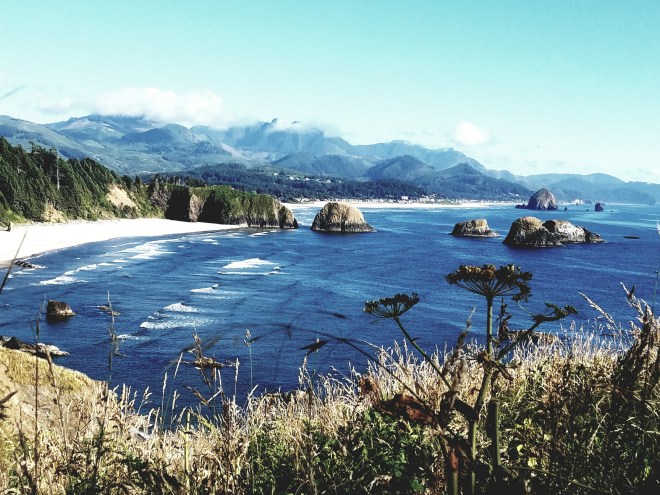
This week, I took my journal and Rilke book with me to the Oregon coast.  The wide swath of sand — broken by the ethereal, craggy rocks and the endless Pacific sea–gathered my attention to itself, and despite my intentions, both book and journal stayed in my bag.IMG_6093
There is something about wide open spaces that is good for the soul, that offers rest to an over-hectic mind.

 Our minds are often cacophonous places.  Our spirits are cluttered with what we must do, where we have failed, and who we must protect.  We cling to these thoughts.  Or they cling to us.  But to be as open and expansive as the sea — who dares to ask for such a gift?

“Our hearts are restless until they find their rest in you,” St. Augustine wrote to God.  What a simple, lovely reminder to step into healing rest.  And what a hard thing to do.  Ironically, we so often work long and hard trying to find rest!  But rest does not need to be earned- it is a divine gift and a relational beckon from Unconditional Love.

I wrote this blessing for a friend of mine at a desperate time in her life.  In this mid-summer moment of busyness, I offer it to you.

 When you have given all you can

and your spirit is drained

and your body worn,

may you find rest.

May you forget about deserve,
earn, 
and not enough.

Instead, may you find grace,

abundant, overflowing.

May you step under this waterfall

and hold up your hands,

drinking your fill.

May the sweat and dirt and tears

from your good labors be washed away;

may every anxious muscle unknot,

and may Peace minister to you.

May you have the wisdom

to put away all that can wait until tomorrow;

may you find a silent space and stay there.

For all that is vital is here now, in this place,

waiting for you.

Open your hands and receive.

May everything in your body
accept goodness;

may you hear the words you long to hear:

Well done, good and faithful one!

May the roots of your longing

drink deeply.

Here’s to cultivating wonder,

Kim

Consider: the Miracle of Existence

Last week in the early hours of Thursday morning, my husband and I were shaken awake with much of western Montana. It took a half moment of groaning joists and rattling dishes for our senses to catch up with reality. Tim’s groggy mind got there first. “Earthquake!” Suddenly wide awake, we both jumped out of bed. As the floor swayed, we briefly dithered over protocol (rouse the kinder? decamp outside?). Before we had made any decisive moves, the shaking slackened, then died away. Everything was still.

Everything, that is, except our nerves. Those were thoroughly rattled.

I palmed my phone and spoke two words to Siri: Missoula Earthquake. Tweets popped like mushrooms in a field. “Anyone else in Missoula feel that earthquake?” inquired several Twitter users. Within seconds an Italian organization released information that a magnitude 5.8 quake had struck 129 km east of Missoula. 5.8 magnitude. 129 km east. I climbed back into bed, embracing these facts and figures like a security blanket. Perhaps it’s a great propensity of the human heart to make order out of chaos. Curiosity and knowledge are incredible gifts. But I couldn’t help detecting in my sudden interest in facts and figures another need. Surely I was seizing upon anything knowable (richter scale readings, kilometers, map locations) to paper over the existential threat shifting beneath me. While the earthquake hadn’t literally yanked a seam of ground apart, it exposed a tremendous fault I usually prefer stays deeply buried.

eeebd4ff-0855-4c02-8ede-71d600244868As I lay back on my pillow, I felt at the mercy of forces operating far beyond human scale. It’s a hereditary susceptibility, I suspect, but I can’t help my anthropocentrism. Human life and human scale are the things I think of, judge from, and orient toward. And here in a most unexpected way, I was woken from a sound sleep in the comfort of my own bed, to be reminded that all the stability and taken-for-grantedness of my world is, literally, built upon shifting ground.

Just as I was drifting back to sleep an aftershock rumbled through. Residents of California and other earthquake active locations may be used to the sensation that the Earth sometimes threatens to buck us all off, but as we say in Montana, “this was my first rodeo.” Several more aftershocks rustled us through the night, and though each rattled the house less and less, I felt wary and fell finally into fitful sleep.

It’s all an incredible miracle, of course, that we exist on this singular globe at all. Every once and again, the Earth makes us aware of the terms of our lease. It rattles the keys and threatens eviction. It reminds us that our human scale is a narrow vantage and things are really far more vast and intricate that we can fathom. No doubt, just as the earthquake shook itself out, my awareness of this miracle will subside. I’ll walk my dog over the same paths I normally do and feel that the ground is stable and knowable, and once again I’ll take my lease for granted. And while I don’t hope to be shaken awake again, I find I’m grateful for the way these shifting plates cracked my consciousness and let a little light in.
Here’s to cultivating wonder,

Lindsay

Rest

For me, summer has always meant a plunge into sweet busyness. A steady, happy clamor accompanies every hour — kids yelling, the zip of the cooler as we pack yet another picnic, feet shuffling in sand, the splash of water at the end of the day as we rinse swimsuits and rack up another load of dishes after dinner.  

But this past weekend, we enjoyed a rare spate of days without guests. We hiked, worked in the yard, and watched the whole miniseries of “Emma.” And one blissful afternoon, I stole away to the hammock where I finished reading a book and then drifted off to sleep. The leaves of the cherry tree stirred in a slight breeze, the dog curled up on my legs, and the neighbors turned off their power tools. Just like that, I floated away from the everyday things — both the blessed and vexing — that nip at my heels. I entered a deep, profound rest. When I awoke an hour later, I felt refreshed down to my bones.

Lately I’ve been talking with others about taking a Sabbath — that is, setting aside a day, or at least a period of time, when I put down all work, open my hands in gratitude, and rest.

It sounds easy, right?  But it’s not.

Disciplining myself to take a day of rest — for me, time without screens or writing or busyness — makes me take a hard look at my own identity. Do I define myself by what I do? Or do I define myself by who I am — that is, a beloved, worthy human, divinely and beautifully fashioned, wholly complete? This is basic stuff, right? But it’s ongoing work, and for many of us, real, fulfilling rest is hard-won.

Taking real rest — being alone with our thoughts and in the space of quiet — opens doors to our hidden wounds and longings. It takes courage to carve out these spaces in our lives, for what the clamor of daily work and necessity obscures comes out of the shadows. While this can be a painful space, it is also the space our souls deeply yearn for. In this quiet we encounter not only what troubles us, but what feeds us deeply. These ritual pauses in our lives open a door to a sacred place where we can find healing and rest.  In the poem, “Sabbath,” Wendell Berry writes:

The mind that comes to rest is tended
In ways that it cannot intend:
Is borne, preserved, and comprehended
By what it cannot comprehend.

We must seek this pearl of great price — the rest which our souls beg for. As Wendell Berry illustrates, we must physically remove ourselves from our work and move to a fundamentally different space. In This Day: Collected and New Sabbath Poems, Berry associates the tilled, orderly farm fields with work, while the woods symbolize rest:

To rest, go to the woods

Where what is made is made

Without your thought or work.

Sit down; begin the wait

For small trees to grow big,

Feeding on earth and light.

Their good result is song

The winds must bring, that trees

Must wait to sing, and sing

Longer than you can wait.

This summer, I hope you will be able to carve out time for real rest. Go to the woods, where what is made is made. Hush your thoughts. Listen to the world, to the voice that calls you by name. Receive your gifts. It is perhaps the kindest thing you will do for yourself all summer.

Here’s to cultivating wonder,

Kim